Contship presents its first Sustainability Report: a new milestone in the Group’s ESG journey.
Contship presents its first Sustainability Report, which sets out its...



La Spezia Container Terminal (LSCT) is the main terminal at the Port of La Spezia.
Established in the early 1970s, it specialises in the handling of containerised cargo, with a strong focus on rail and intermodal transport.
Today, LSCT is one of Italy’s main gateways for container traffic, with a handling capacity of 1.4 million TEUs. The terminal has 986 metres of quay dedicated to containers, 1,390 metres of general cargo quay, a water depth of 15 metres and a storage capacity of 28,000 TEUs.
In addition to handling containerised cargo, the terminal manages break bulk and project cargo, as well as value-added services such as container stuffing and unstuffing, storage, and the maintenance and repair of both refrigerated and standard containers.
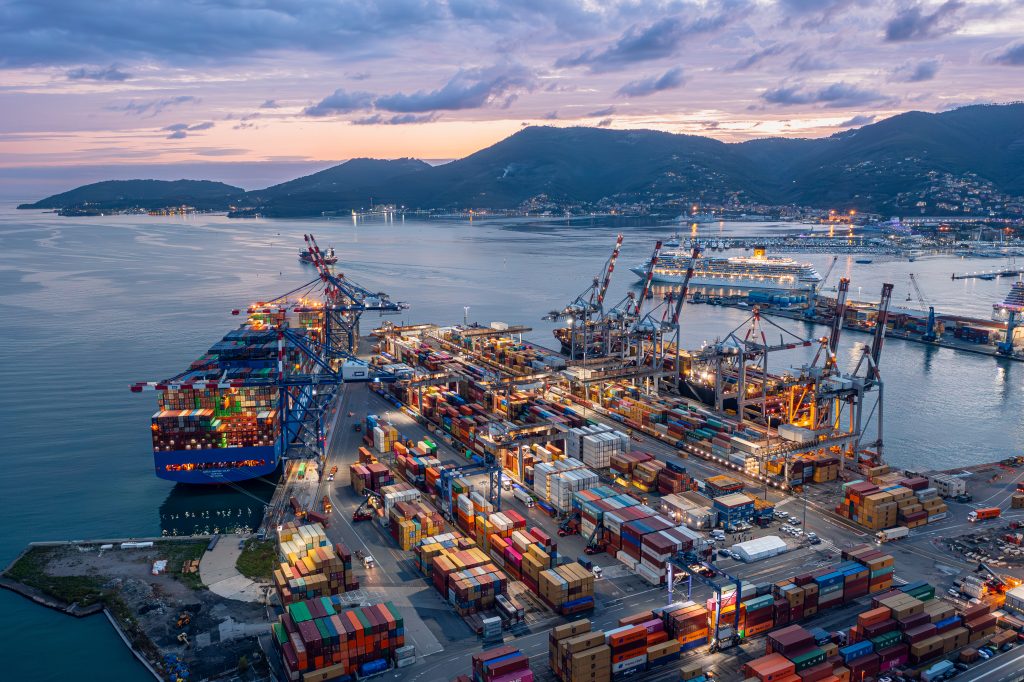
Quay operations at the LSCT terminal mainly involve two areas: the Garibaldi Quay and the Fornelli Quay (East and West). This configuration allows for the simultaneous berthing of two 14,000 TEU vessels (the standard capacity of vessels operating on the Asia-Med route).
Fornelli East Quay is the terminal’s main one: it features a greater draught and ship-to-shore cranes capable of operating on the latest-generation vessels, reaching up to the 23rd row of containers. A further six STS cranes are positioned along the west quay: of these, four can operate on 20 rows of containers and two on 18 rows.
Customers who choose La Spezia Container Terminal can rely on its strategic location, an extensive network of sea and rail connections, and infrastructure dedicated to container handling.
Deep-sea services connect LSCT to the main international routes, whilst rail links provide access to the key markets of Northern Italy and Central and Southern Europe. The experience gained in the sector, and investments in infrastructure and equipment are driving the terminal’s development and the enhancement of the services offered.
Operational efficiency and a focus on customer needs have always been key priorities for LSCT; in this context, an investment plan of 350 million euros is currently underway, involving the expansion of the terminal through the construction of a new quay and the upgrading of infrastructure and equipment.
Among the main projects planned is the development of the new Ravano Quay, aimed at increasing the terminal’s operational capacity, improving the efficiency of logistics flows and strengthening the integration between terminal operations and the rail network. The Ravano quay will, in fact, be capable of simultaneously accommodating and handling up to three large container ships (ULCVs, Ultra Large Container Vessels) of 24,000 TEU and will be equipped with a new railway facility comprising five tracks, enabling LSCT to increase its share of intermodal traffic. The aim is to increase the overall share of rail transport from the current average of 33% to 50%, with one in every two containers handled by rail.
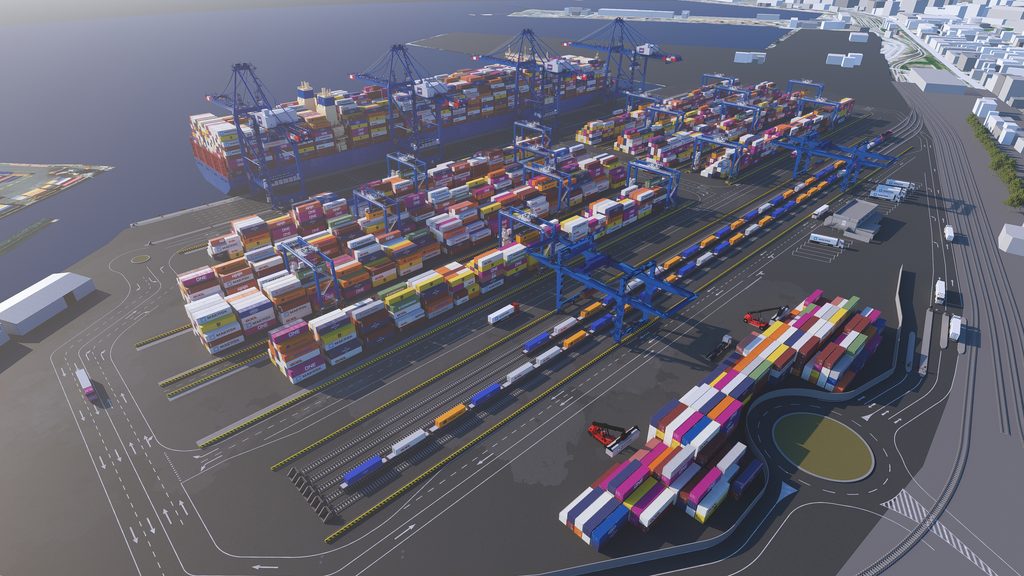
The new quay cranes will be designed to integrate technological systems; the planned solutions include automatic container identification using OCR (Optical Character Recognition), digital tracking of truck positions during loading and unloading, and scanning of the ship’s profile. The new yard vehicles, on the other hand, will feature a cabless design – that is, without an on-board driver’s cab – and will be equipped for remote control.
Cold ironing will significantly reduce ships’ emissions whilst they are berthed.
To complete the terminal’s development plan, modernisation and upgrading works are planned for the infrastructure at Molo Fornelli. In addition to a new automated access gate, which is already operative, a new M&R workshop and a new building for operational offices will be constructed, and modernization works will be carried out on the quay and yard equipment.
Overall, the project will strengthen LSCT’s operational capacity and competitiveness, thereby consolidating the role of the La Spezia terminal as a strategic gateway in the Mediterranean.
The LSCT terminal enables customers to access the markets of Northern Italy and Central and Southern Europe, capitalising on its strategic location and the numerous deep-sea services that follow the main import-export shipping routes and connect the Mediterranean with Asia and the Americas.
La Spezia Container Terminal counts amongst its customers the major shipping companies, including those belonging to the leading shipping alliances (Gemini Cooperation, Premier Alliance and Ocean Alliance), as well as MSC, which operates an independent network. Collectively, these operators account for a significant share of the cargo capacity utilised on the main east-west maritime routes.
The terminal’s catchment area covers a large national catchment area extending across central and northern Italy and, internationally, reaches the main markets of central and southern Europe, including Austria, Switzerland and Germany. Supporting this connectivity, Rail Hub Milano (RHM), the Contship Group’s inland terminal, serves as a major intermodal rail hub, linked to LSCT via high-frequency rail services, thereby extending the terminal’s reach and facilitating access to European markets.
Thanks to this integrated intermodal system, LSCT complements its role as a Mediterranean gateway with a service tailored to markets beyond the Alps, contributing to the development of the Southern Gateway – an efficient solution for accessing the markets of central and southern Europe as an alternative to the traditional ports of Northern Europe.
LSCT is linked to the national motorway network via the A12, one of Italy’s main motorways, which runs from Genoa along the entire Ligurian coast until it reaches Tuscany and Lazio.
Another key motorway junction, vital for the development of the central and northern markets, is the A15 motorway, which, by connecting to the A1, provides quick access to Emilia-Romagna and the other regions of northern Italy.
Another key factor that sets LSCT apart in terms of efficiency is its rail connectivity. La Spezia Container Terminal operates over 150 trains a week to destinations in Italy and across Europe.
One of the main routes is the service that connects La Spezia to the Rail Hub Milano in Melzo several times a day. The service, operated by Hannibal – the Contship Group’s Multimodal Transport Operator (MTO) – links the port to the group’s intermodal hub in Lombardy, with the option of onward transport to Northern European markets.
Further rail links from La Spezia also provide access to the intermodal centres in Modena, Padua and Ravenna.
Overall, LSCT has a handling capacity of 1.4 million TEUs per year, 986 metres of dedicated container quay, 1,390 metres of general cargo quay, a draught of 15 metres and a storage capacity of 28,000 TEUs. This configuration enables the terminal to handle large vessels and international containerised traffic.


